| |||||||||||||||||||||||||
 Prohibida su reproducción total o parcial, así como su traducción a cualquier idioma sin autorización escrita de su titular. Reproduction in whole or in part, or translation without written permission is prohibited. All rights reserved. |
Wednesday, September 12, 2007
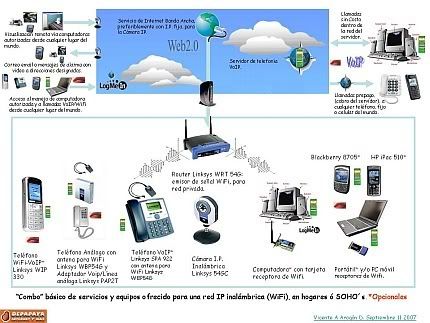
"Combo" básico para aprovechar facilidades Web2.0


Thursday, August 30, 2007
Servicio de música directamente bajado desde Internet a un celular,utilizando conexiones WiFi.
 TECHNOLOGY |
| Nokia to Introduce Digital Music Service By ERIC PFANNER Published: August 30, 2007 |
|
|
| LONDON, Aug. 29 — In the same converted 19th-century fish market where Apple announced the European introduction of its iTunes music store three years ago, Nokia said on Wednesday that it would soon introduce its own digital music service, along with an easier-to-use Apple-style mobile interface and an Apple-style touchscreen handset. The Nokia Music Store, to open this year, will let users download songs from the Internet to their computers or directly to mobile phones over wireless networks, which Apple's recently released iPhone cannot do. Analysts said the move heightened the rivalry between Nokia and Apple at the high end of the mobile phone business. "It was obviously going straight at Apple," said Seamus McAteer, senior analyst at M:Metrics, a research firm. While Nokia executives chose suits and ties rather than the black mock turtlenecks and blue jeans favored by Steven P. Jobs, Apple's chief executive, they acknowledged that Nokia was not above imitating its rival. "I don't know what is copying and what is original but if there is something good in the world, we copy it with pride," said Anssi Vanjoki, head of the Nokia multimedia division, which makes the company's high-end handsets, when asked about similarities between the iPhone, iTunes and the new devices and services announced by Nokia. In offering direct downloads, the Nokia Music Store goes beyond iTunes, which requires users to download songs to their personal computers before transferring them to an iPod music player or an iPhone. The Nokia store, which the company said would be made available first in important European markets, could put pressure on Apple to develop a similar service, analysts said. The music store also potentially puts Nokia into conflict with operators of mobile networks, which in many cases have developed music services of their own. But analysts say that outside of Asia, mobile phone services like music have been relatively slow to take off, despite the tens of billions of dollars that network operators have poured into the technology to enable them. "Now Nokia is saying, 'You guys had your chance to run music stores, or whatever, and it didn't work, so now we're going to give consumers what they want,' " said Paul Jackson, an analyst at Forrester Research. In addition to the music store, Nokia said it would revive a game platform called N-Gage, with a number of video game publishers agreeing to supply games to download. The company said it would make all of its mobile content and Internet services available under the brand Ovi, which means door in Finnish. Nokia, which is based in Finland, showed pictures and video clips of the interface that will allow users to navigate through the various Ovi services. Analysts said it appeared to resemble the interfaces for the iPod, iPhone and iTunes, whose simplicity has been seen as a chief selling point. But analysts said they were frustrated by a lack of detail about the Ovi offerings. "It's a bit of an empty shell for now," said Mark Newman, chief research officer at Informa Telecoms and Media. Nokia also introduced several phone models on Wednesday with increased storage capacity for music and other media content and said it would introduce its touchscreen phone next year. While Nokia clearly has one eye on Apple, analysts said network operators might more directly feel its move into services, and that could affect relationships with device manufacturers. Orange, which is part of France Télécom, for example, has a partnership with the phone maker Sony Ericsson, under which its Walkman-branded phones send users to the Orange music store at the touch of a button. Apple, meanwhile, has signed an exclusive iPhone distribution agreement with AT&T in the United States and is reportedly pursuing similar arrangements for the pending introduction of the phone in Europe. Analysts said mobile operators who agreed to carry certain Nokia multimedia phones might try to demand that the company disable features that overlap with the carriers' own services. Yet Nokia has a strong negotiating position, analysts added, because it sells about 400 million phones a year — more than one-third of the global market — so the network operators might not be able to drop a popular handset from their lineups. Despite all the jockeying for position, the appeal of mobile download services remains uncertain. Even in the leading European market for mobile music, Britain, fewer than 3 percent of cellular subscribers downloaded songs wirelessly in January, according to M:Metrics. About 12 percent of subscribers, meanwhile, listened to music that had been transferred to their phones from personal computers. "How to get them to switch over to something like the Nokia music store remains unclear," said Martin Garner, an analyst at Ovum. Nokia said it would price music downloads at 1 euro for each song, or 10 euros for each album, in the same price range as many existing mobile music services. In addition, customers would have to pay for the use of phone networks for the download, though many operators are starting to offer monthly flat-fee packages. |
 Nokia, via Reuters
Monday, August 27, 2007
Llegó tarde al negocio de ventas por Internet ? Aún hay mucho dinero ahí.
TECHNOLOGY E-Commerce Report |
| Late to Web Retailing? There's Still Money There By BOB TEDESCHI Published: August 27, 2007 |
|
|
| DURING the tech bust, GSI Commerce Inc. was the company that salvaged many operations. Beginning in 2000, as start-ups failed, GSI increased its business by buying distressed online retailers like Fogdog.com and Ashford.com, and running the entire operations more efficiently than the retailers could themselves. Now the business, which makes money by helping companies like Toys "R" Us and Linens 'n Things operate online stores, hopes it can again raise its growth through an acquisition of a different kind. The company, which is based in King of Prussia, Pa., announced this month that it would buy privately held Accretive Commerce, one of GSI's few big competitors, for $97.5 million in cash. The acquisition should help GSI maintain its position as the leader in this niche, analysts said. But no matter who may be in the lead, just about everyone is doing well, thanks to new investments in e-commerce technologies and services by traditional retailers, like Diane von Furstenberg and Tommy Bahama, and others. "These companies are all experiencing growth, and a lot of it is coming from the late bloomers," said Sucharita Mulpuru, a retail analyst with Forrester Research. "There are also tons of companies that may have had some semblance of a Web presence who are now building out their e-commerce functionality." GSI, for instance, signed an agreement this year to build the first e-commerce site for Gordon's Jewelers, a division of Zale Corporation. And last week, GSI unveiled a revamped e-commerce site for the Public Broadcasting Service, ShopPBS.com. Assuming its deal with Accretive closes as expected within the next two months, those clients will line up with roughly 15 other customers that Accretive had attracted in recent years, including American Eagle Outfitters and Restoration Hardware. Analysts said the purchase is a good defensive measure, as Accretive had competed directly with GSI. But according to Michael G. Rubin, GSI's chief executive, the acquisition is significant in that it improves the company's flexibility. GSI makes most of its money by signing up stores for all-in-one packages of e-commerce services, in which GSI designs and manages the Web site, carries inventory and handles shipping — in most cases, running the entire online operations for clients. In exchange, it keeps an undisclosed share of the revenues. The Accretive acquisition underscores a shift in strategy, where GSI is giving clients more options, like e-mail promotions or Web site design, for a flat fee. |
|
|
| GSI's shift away from a one-size-fits-all approach is a wise one, said Aaron Kessler, an analyst with Piper Jaffray, an investment firm. Mr. Kessler said that the company's increased focus on selling advertising services to its clients, in particular, "helps them become more of an agency. That's a higher-margin business." Some of Accretive's customers pay others like ATG, an e-commerce software company, to build their Web sites, or install software to help manage their inventory of goods online. But because GSI also sells the same services and products to clients, its acquisition of Accretive could have ripple effects for ATG. Bob Burke, ATG's chief executive, said he expected to keep Accretive's customers even after the business moves to GSI. GSI, a publicly traded company, reported that its second-quarter revenue increased about 10 percent from the same period a year earlier. Before announcing the Accretive acquisition, GSI said it had expected sales for its fiscal year to top $721 million, and net income to reach more than $41 million. One curious development in this category in recent years is what analysts have characterized as the diminished stature of Amazon.com. Several years ago, Amazon opened a new line of business it called Enterprise Solutions, by signing Borders, Toys "R" Us and other big retailers to deals in which Amazon would essentially run the e-commerce operations of those businesses. The Toys "R" Us partnership, though, devolved into a bitter dispute in 2004 after the toy retailer accused Amazon of violating their contract by allowing competing toy sellers to offer goods on Amazon.com. Amazon lost the ensuing lawsuit last year, which released Toys "R" Us from the partnership. Borders has said it would not renew the Amazon deal when it expires next year. Mr. Kessler, of Piper Jaffray, said Amazon "has made a strategic decision to stop competing for larger players." An Amazon spokesman, Craig Berman, declined to comment on Mr. Kessler's statement. "Enterprise Solutions is an important option for merchants, along with the other offerings we have," he said. "And it's an important component to be able to offer merchants, regardless of their size." Fry Inc., which builds and operates Web sites on behalf of companies like Brookstone and Godiva also has benefited from more demand from retailers. According to David Fry, the company's chief executive, sales have increased by 30 percent over the past two years. (The company is privately held and does not disclose revenue figures.) Mr. Fry said that sales should continue to grow briskly, despite GSI's strengthened competitive position, and despite a general slowdown in the domestic growth of e-commerce sales. E-commerce executives, he said, will need expertise to compete. "As an e-commerce manager, in the past, you didn't have to do anything to get 30 percent growth," Mr. Fry said. "Now, you have to do what other people do: work for a living and take customers away from your competitors." |


Monday, August 20, 2007
Remote ASP access services to PC.s
 Abrir artículo en el Browser. Abrir artículo en el Browser. | ||
| May 24 , 2005 Remote Access between PC´s. By Cade Metz In years past, remote control and remote access weren't exactly technologies of the masses. Complicated and expensive, applications like Laplink and pcAnywhere were rarely used by anyone other than IT professionals and other seasoned computer users. In recent years, all this has changed, with dramatic improvements in the usability and pricing of utilities that give you access to your other PCs, whether they're across town or on the other side of the world. Which is right for you? Much depends on how many machines you have, how you use them, and how much you're willing to spend. With some services, the base price gives you remote access to only one machine. And though most give you a discount if you sign up for a full year of service, these vary from about 10 percent (FolderShare) to 55 percent (LogMeIn Pro). | ||
 | ||
| Despite its many imitators, the original, GoToMyPC ($19.95 per month and up), is still the most effective remote control tool on the Web—and the easiest to use. You can tap into a remote PC from any Java-enabled browser, freely navigating its OS as if it were right there in front of you. Equipped with a built-in file transfer tool, it's a great way to access important data. But it's also great for support. In accessing a friend's machine, not only can you navigate the system, but you can also chat and draw on the friend's desktop with a virtual marker. If need be, you can even reboot your remote system. But the real beauty of the app is how easy it is to use. You simply download a small client to the PC you want to control and assign a password to the system. From then on, you can access your machine by logging on to your account and keying in the system password. GoToMyPC does cost a pretty penny, and though it can be used on certain wireless handhelds, it doesn't work well over dial-up connections. ($9.95 per month) solves both these problems. It's cheaper than GoToMyPC, and though it does offer full remote control, it can also make low-bandwidth HTML-based connections, accessing only certain important parts of a remote system, including your e-mail in-box, your calendar, and your file tree. This sort of approach is ideal for use over dial-up or on a wireless handheld. But the full remote control isn't as slick or as fast as what you get with GoToMyPC, and the low-bandwidth functions are only marginally useful if your remote machine isn't running Microsoft Outlook or Outlook Express. | ||
 | ||
| ($9.95 per month) carries the same price tag as Laplink Everywhere and operates along the same lines. You can do full remote control, or you can opt for quick and dirty HTML connections. The difference is that its full remote control, while still not the equal of GoToMyPC's, is far more impressive than Laplink's. One nice bonus here: You can stream video from a remote PC's webcam. Not only can you check up on your PC, you can even check up on the room it's sitting in. I f you have a webcam installed, I'm InTouch automatically finds it and starts streaming video as soon as you click the appropriate link.  Don't want to spend even $10 a month? 3am Labs' LogMeIn Basic gives you full remote control, free. It won't transfer files to and from your remote PC or do remote printing, but it's nearly as slick and as fast as GoToMyPC, and if you need to transfer files, you can do so by remote-controlling e-mail. The company has two more powerful versions of the product, each $12.95.
WebEx's free product, MyWebEx PC, isn't quite as impressive as LogMeIn. With the free version of LogMeIn, for example, you can access an unlimited number of remote machines, whereas MyWebEx PC limits you to one.(Webex free is no longer available. July 2007) But its designers have worked out a few bugs since we first reviewed the product in February, and the full version of the tool, which includes file transfer, remote printing, and application-specific access much like you get with Laplink Everywhere, is only $9.95 per month. BeInSync or ByteTaxi's FolderShare Install BeInSync ($59.95 per year) or ByteTaxi's FolderShare ($48.60 to $72.90 per year) and you may not need remote control. Each of these apps lets you keep certain files and folders automatically synchronized between two or more machines. You can also use them to share files with other users—and yes, you can do remote access from any Web browser with either service. Both are available free, in limited form, and they're far more versatile than standard remote control apps. BeInSync's interface is more intuitive. Unlike FolderShare, it lets you easily synchronize e-mail messages, contacts, and bookmarks, not just files. But the company has yet to pin down its price, saying that it will up the annual rate to $99.95 but not committing to a date or even to a general time frame. | ||
|

Subscribe to:
Posts (Atom)